What Do Red Light Masks Do? Understanding LED Light Therapy and a Cellular Approach to Skin Repair
30 May 2026
0 comments
Red light therapy masks have become one of the most visible skincare categories in recent years. Scroll through any social platform and you will see people wearing what looks like futuristic face shields, glowing red or near-infrared, with claims ranging from "fades fine lines" to "stimulates collagen production." The technology is genuinely interesting — photobiomodulation, the scientific term for what red light does to skin cells, has been studied for decades in medical settings. But the gap between clinical applications and what an at-home mask can deliver deserves honest examination.
The Science: How Red Light Therapy Works
Red light therapy operates on a specific wavelength range — 630 to 660 nanometers for visible red light and 830 to 850 nanometers for near-infrared. Dr. Eleonora Fedonenko, a board-certified dermatologist, explains in CNET's 2026 expert guide that "red light should be between 630 and 660 nanometers, and near-infrared light should be between 830 and 850 nanometers since they're the two wavelengths most commonly shown to promote collagen growth while reducing inflammation" (Fedonenko via CNET, 2026).
At these wavelengths, light energy penetrates the skin to varying depths — red light reaches the upper dermis, near-infrared goes deeper — and interacts with cellular components called chromophores. The primary target is cytochrome c oxidase, an enzyme in the mitochondrial electron transport chain. When red light photons hit this enzyme, they increase its activity, which raises adenosine triphosphate (ATP) production. More ATP means cells can perform repair functions more efficiently. Downstream effects include increased fibroblast activity, boosting collagen and elastin synthesis, and modulation of inflammatory cytokines, reducing redness and swelling.

What At-Home Masks Can Reasonably Deliver
At-home red light masks operate at lower irradiance — the power output per square centimeter — than the devices used in dermatology clinics. Dr. Fedonenko notes that FDA-cleared devices typically have an irradiance of at least 30 mW/cm², while she advises caution with masks below 10-30 mW/cm², stating that "even though the light penetrates the skin, it's not strong enough to yield results, as it elicits little measurable cellular response" (Fedonenko via CNET, 2026).
Consistency matters more than most users realize. The science-backed resource SeekRedLight details a realistic results timeline: a subtle glow appears within 1-2 weeks from improved blood circulation, noticeable texture improvement by weeks 3-4, fine line reduction by weeks 6-8, and deeper wrinkle softening after 2-3 months (SeekRedLight, 2026). The source emphasizes that "collagen synthesis takes time regardless of what device you use. Your fibroblasts need approximately 4-12 weeks of consistent stimulation to produce enough new collagen to visibly change your skin's structure."
The recommended usage frequency is 3 to 5 sessions per week, at 10 to 20 minutes each. Dr. Fedonenko specifically warns against daily use, noting that "patients have come in with skin that was so tight and raw, they were using the mask every day in order to speed up their results" (Fedonenko via CNET, 2026). The light stimulates cellular repair, and skin needs recovery time between sessions.
The Biological Ceiling: What Red Light Cannot Do
Red light therapy stimulates cells to produce more collagen. It does not provide the building blocks for that collagen. It signals. It does not supply.
This distinction matters. Photobiomodulation is a trigger — it tells fibroblasts to work harder. But fibroblasts need amino acids, vitamins, lipids, and hydration to actually synthesize new collagen and elastin. A red light mask can increase the demand signal, but if the skin lacks the raw materials for repair, the supply chain fails to deliver.
Additionally, photobiomodulation follows a biphasic dose response. Too little energy produces no effect. Too much can generate reactive oxygen species and cause oxidative stress, counteracting the benefits. Dr. Amy Bandy, a board-certified plastic surgeon quoted by CNET, adds that "if someone is treating themselves too frequently and/or simultaneously utilizing very harsh skin care products such as retinoids or exfoliating acids, the skin barrier may become damaged, which leads to further inflammation and irritation" (Bandy via CNET, 2026).
Cellular Repair, Not Just Cellular Stimulation: The PDRN Approach
If red light therapy is the trigger — the signal telling skin cells to get to work — then PDRN (Polydeoxyribonucleotide) represents a different category entirely. PDRN provides the signal and some of the building material at the same time.
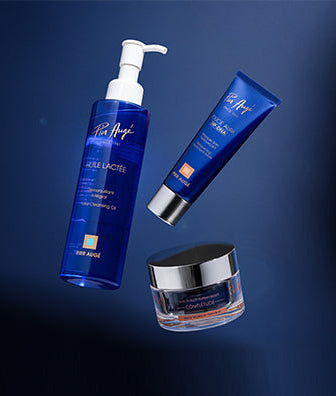
Pier Augé, a French pharmaceutical skincare founded in 1961, was the first brand to incorporate high-purity PDRN into cosmetic formulations, beginning in 1979. Their approach to glass skin repair combines DNA-level regeneration with barrier restoration. The ingredient is extracted from wild salmon milt and refined to 99% purity, with a 98% structural similarity to human DNA. When applied topically, these long-chain DNA fragments function as biomimetic signaling molecules — the skin recognizes them at the molecular level and responds by activating its intrinsic repair mechanisms, including collagen synthesis, cell proliferation, and barrier restoration.
The mechanism is complementary to, but distinct from, photobiomodulation. Red light stimulates mitochondria to produce more energy. PDRN provides the signals that tell cells how to use that energy for repair. One is the accelerator pedal. The other is the navigation system.
Pier Augé built its entire product line around this insight. The brand's founding principle — "since the skin is a formula, it must be possible to reproduce it" — came from Pierre-Jules Augé's pharmaceutical training at the University of Tours and his years of clinical experience treating severe skin damage during medical missions in Africa. His observation was that healthy skin requires a precise balance of five elements: water, lipids, vitamins, carbohydrates, and proteins. All Pier Augé formulations are built around replicating that balance.
The Douce Aura Overnight Sleeping Mask is the product where PDRN technology is most concentrated. Clinical testing on 33 women over 14 days — an unusually transparent data point in an industry that often hides behind vague "consumer perception studies" — showed a 52.69% radiance boost and a 45.86% hydration surge within 15 minutes of application. Over the two-week period, wrinkle depth decreased by 20.69%, skin plumping improved by 14.82%, and firmness increased by 4.50%. These numbers come from instrumentation, not self-reporting.
For more comprehensive anti-aging support, the Firming Tri-Active Cream adds a multi-peptide complex — including Acetyl Hexapeptide-8 and Palmitoyl Peptides — to the PDRN backbone. Niacinamide addresses tone evenness, and meadowfoam seed oil provides barrier lipids. The combination of DNA-level signaling plus peptide-level structural support creates a multi-layered regeneration approach that addresses both the trigger and the supply sides of skin repair.

Integrating the Two Approaches
There is no reason red light therapy and PDRN-based skincare cannot coexist in the same routine. In fact, they may work better together. Red light stimulates fibroblast activity. PDRN provides the biomimetic signals that direct that activity toward productive repair rather than disorganized collagen deposition. Using a PDRN overnight mask after a red light session may help the skin use the energy boost from photobiomodulation more efficiently.
But for anyone who finds the red light mask routine tedious — the 10 to 20 minutes of sitting still, the inconsistent results, the months of waiting for subtle changes — PDRN-based skincare offers a path to regeneration that does not require a device, a charging cable, or a daily calendar reminder. The Douce Aura mask gets applied, melts in over 10 minutes, and works while you sleep. The Firming Tri-Active Cream goes on morning and night. Both leverage the skin's own repair biology rather than overlaying an external energy source and hoping for the best.
The Bottom Line
Red light therapy masks are legitimate technology with a real mechanism. The clinical evidence for photobiomodulation in anti-aging is credible, if modest in absolute magnitude, and the at-home versions are safe when used correctly. But they are signal-only interventions — they tell cells to work harder without necessarily providing the resources for that work.
Pier Augé's approach operates at a different level. Instead of shining light on the skin from the outside and hoping it triggers the right response, the brand formulates ingredients the skin already recognizes — PDRN with 98% human DNA similarity, lipids that match the skin's own composition, vitamins and proteins in biomimetic ratios — and lets the skin's biology take over. It is the difference between knocking on the door and having the key.
For anyone exploring anti-aging options, the decision is not which technology to choose exclusively, but how to build a routine where each element plays its appropriate role. Red light for cellular energy. PDRN for cellular repair. Together, they cover more of the biological picture than either one does alone.