How to Make Face Mask at Home — Simple DIY Recipes and What to Know Before You Start
31 May 2026
0 comments
Mixing up a face mask in your own kitchen has a certain appeal. It costs next to nothing, you know exactly what went into it, and there is something genuinely satisfying about turning pantry staples into a self-care ritual. The internet is packed with recipes — honey and oatmeal, yogurt and turmeric, mashed avocado with a drizzle of olive oil — and plenty of people swear by them.
But before you raid the refrigerator, it helps to understand what homemade masks can and cannot do. Because the skin is not a mixing bowl, and not everything that is safe to eat belongs on your face.
Why DIY Face Masks Are So Popular
The appeal starts with accessibility. Most recipes call for ingredients you already have: honey sits in the cupboard, rolled oats hide behind the rice, a ripe banana is about to go bad. There is no shipping fee, no waiting, and no sticker shock.
Then there is the control factor. If you have sensitive skin and have been burned by store-bought products that promised one thing and delivered redness instead, the idea of using a single ingredient you trust feels safer. No fragrance, no preservatives, no ingredient list that requires a chemistry degree to read.
Budget is another driver. A jar of professional-grade face mask can run anywhere from $30 to over $100. A spoonful of honey, a splash of milk, and some ground oats cost pennies by comparison.
What Actually Works: Three DIY Recipes Worth Trying
Not all kitchen skincare is created equal. Some ingredients have properties that align with what skin actually needs. Here are three combinations where the logic holds up.

Honey and Oatmeal Soothing Mask
Honey is a natural humectant — it pulls moisture from the air into the skin — and has mild antibacterial properties. Finely ground oatmeal contains avenanthramides, compounds that calm inflammation and itch. Together, they make a gentle mask for dry, irritated, or winter-stressed skin.
Mix one tablespoon of raw honey with one tablespoon of finely ground oats. Apply a thin layer, leave for 10 to 15 minutes, then rinse with lukewarm water while massaging gently in circles to get the oat exfoliation bonus.
Yogurt and Turmeric Brightening Mask
Plain yogurt delivers lactic acid, a mild alpha hydroxy acid that loosens the bonds holding dead skin cells together. Turmeric's curcumin is an antioxidant studied for its anti-inflammatory effects — though the concentration you get from a sprinkle of kitchen spice is nowhere near what clinical studies use.
Combine one tablespoon of plain full-fat yogurt with a small pinch of turmeric. Apply thinly, leave for 10 minutes, and rinse thoroughly. Important: turmeric stains everything it touches, so use an old towel.
Avocado and Olive Oil Hydrating Mask
Ripe avocado is rich in fatty acids and vitamin E, both of which support the skin's moisture barrier. Olive oil adds more lipids. For skin that feels tight, rough, or windburned, this combination offers genuine relief.
Mash a quarter of a ripe avocado until smooth, stir in half a teaspoon of olive oil, apply evenly, and leave for 15 minutes. Rinse with warm water and pat dry.
What You Should Probably Skip
Some popular DIY ingredients cause more harm than good. Lemon juice, despite its vitamin C reputation, has a pH around 2 — far too acidic for facial skin — and combined with UV exposure it can trigger phytophotodermatitis, a rash of dark, stubborn patches. Baking soda has a pH around 9, which disrupts the skin's acid mantle, the protective layer that keeps bacteria out and moisture in. Cinnamon and cayenne can set off chemical burns and contact dermatitis, particularly on facial skin, which is thinner than skin anywhere else on the body.
Dr. Alexandra Bowles, a board-certified dermatologist at Mona Dermatology, advises that "while natural ingredients are often perceived as safe, they can still be harsh on your skin. Ingredients like lemon juice or baking soda, for example, may sound gentle but can irritate your skin, especially with regular use" (Mona Dermatology, 2025). She also recommends limiting DIY mask use to once or twice a week — "more isn't always better when it comes to skincare."
The Real Limitation of DIY Masks
Here is the honest problem: most food ingredients have molecules too large to penetrate the stratum corneum, the outermost layer of the skin. That avocado sits on top of your face. The honey provides surface hydration while it is on, then washes away. The turmeric curcumin, even if stable — which it is not, it oxidizes within minutes of exposure to air — cannot reach the epidermis in meaningful concentrations from a kitchen pinch.
This is not just intuition. A 2026 scientific review by Dr. Meriem Taleb, PhD, published on Dr. Meri's, explains that the skin barrier, particularly the stratum corneum, limits penetration of hydrophilic molecules such as vitamin C. Effective absorption requires a pH below approximately 3.5, a concentration between 10% and 20%, and chemical stability of the active compound — conditions that homemade masks simply cannot meet (Taleb, Dr. Meri's, 2026). "Homemade masks generally contain low concentrations of active compounds, undergo rapid oxidation upon exposure to air, and lack controlled pH. Their effects are primarily limited to surface hydration, mild exfoliation through organic acids, and temporary enhancement of skin brightness."
What DIY masks do well is provide temporary surface hydration, gentle physical exfoliation, and a pleasant ritual. They do not deliver active ingredients at clinically effective concentrations. They do not trigger cellular repair processes. They do not produce lasting change.
For many people, that is fine. A mask that makes your face feel softer for a few hours is still a mask worth using. But if your goal is something deeper — repairing a compromised barrier, reversing dullness that does not budge, smoothing texture that has been there for months — then formulation science matters.
Beyond the Kitchen: When Formulation Science Makes the Difference
This is where a conversation about professional skincare becomes relevant. There is a difference between a mask that sits on the surface and a mask designed to interact with skin at the cellular level. French pharmacy skincare, in particular, has a history of approaching product development like pharmaceutical research — precise concentrations, clinically tested claims, active ingredients selected for their molecular compatibility with human biology rather than their availability in the produce aisle.
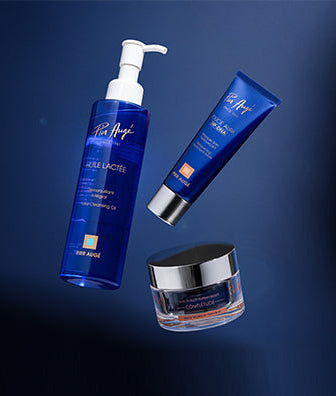
Pier Augé, a French skincare maison founded in 1961 by two pharmacists, operates on exactly this principle. The brand's founding philosophy came from Pierre-Jules Augé's observation that "since the skin is a formula, it must be possible to reproduce it." Rather than borrowing ingredients from the kitchen, the brand builds formulations around what skin is actually made of: water, lipids, vitamins, carbohydrates, and proteins — the five elements that constitute healthy skin. This biomimetic approach means the formulas deliver ingredients the skin already recognizes, improving absorption without irritation — an approach that powers their entire overnight repair lineup.
The product that most directly demonstrates the gap between kitchen masks and laboratory formulations is the Douce Aura Overnight Sleeping Mask. It solves three problems that DIY masks cannot solve.

First, the active ingredient: high-purity PDRN (Polydeoxyribonucleotide), extracted from wild salmon milt and refined to 99% purity. PDRN has a 98% structural similarity to human DNA. When applied to skin, those long-chain DNA fragments act as biomimetic signaling molecules — the skin recognizes them and responds by ramping up its own repair processes, including collagen synthesis. This is a fundamentally different mechanism from a honey humectant. One tells skin to repair itself. The other temporarily adds surface moisture.
Second, the clinical data. A clinical study conducted by Pier Augé on 33 women over 14 days showed measurable results: a 52.69% boost in skin radiance and a 45.86% hydration surge within 15 minutes of application, and over two weeks, a 20.69% reduction in wrinkle depth, a 14.82% improvement in skin plumping, and a 4.50% increase in firmness. These are results that come from validated instrumentation, not from "my skin feels softer" anecdotes.
Third, the format itself. Douce Aura has a snow-melt texture — it applies as a creamy white layer and, over about 10 minutes, melts into a transparent, weightless veil that absorbs without residue. No rinsing required. You apply it, it disappears into the skin, and by morning your skin looks like you slept 10 hours even if you got five. For anyone who has ever rinsed oatmeal out of their sink at midnight, that convenience alone is worth noting.
The mask is suitable for all skin types — the lightweight texture works even on combination skin without creating greasy zones — and it is safe for post-laser or post-peel recovery, making it useful when skin is at its most vulnerable and a kitchen experiment would be out of the question.
When to DIY and When to Go Pro
Both approaches have a place. Make a honey-oatmeal mask on a Sunday afternoon when the goal is relaxation and a bit of surface softness. It costs almost nothing, and the ritual itself has value.
But for days when skin needs actual repair — when it looks dull despite decent sleep, when fine lines seem more pronounced than they were last month, when the barrier feels compromised after too much sun or a round of active ingredients — a formulated product with validated concentrations and clinical testing becomes worth the investment.
Pier Augé's Douce Aura Overnight Mask represents that second category: a product built on six decades of pharmaceutical skincare research, driven by a repair-first philosophy rather than a marketing brief, and backed by data rather than recipe blogs. The brand's heritage — founded by pharmacists who spent a decade providing free medical care in Djibouti, developing a repairing balm tested on thousands of clinical cases — gives the claim of "repair" more weight than it carries in most marketing copy.
At the end of the day, your skin will make the decision. A surface-level mask feels nice. A repair-level mask changes what the skin is capable of. Both are useful — just know which one you are actually getting.