What Do Face Mask Do? A Detailed Look at How Facial Masks Actually Work
31 May 2026
0 comments
Title: What Do Face Masks Do for Your Skin? A Science-Backed Guide
Description: Learn what face masks do for your skin, from hydration to anti-aging, and why overnight repair masks with PDRN technology deliver deeper results.
Keywords: what do face mask do, what do face masks do, what do facial masks do, what does a face mask do, what does a facial mask do, what is a face mask for, do face masks actually work for skin, what do face masks do for your face
What Do Face Mask Do? A Detailed Look at How Facial Masks Actually Work
Walk through any skincare aisle and you will find an overwhelming selection: sheet masks, clay masks, overnight masks, peel-off masks, cream masks. The packaging makes confident claims — "intensive hydration," "pore-refining," "instant glow" — but what do face masks actually do, and how much of it is real?
The short answer: face masks work primarily through occlusion, concentration, and contact time. According to the American Academy of Dermatology, "facial masks can help moisturize and strengthen your skin barrier, and help combat signs of skin aging," and because "facial masks cover your skin and you don't wash them off immediately, the active ingredients have time to absorb into your skin" (AAD, 2026). That combination — longer contact, higher concentration — is what creates the temporary but visible boost most masks deliver.
But different masks do different things, and understanding the mechanics behind each type helps you pick the right one for your skin.
The Occlusion Effect: Why Masks Work Differently Than Serums
The core mechanism behind most face masks is simple but powerful. When you apply a mask and leave it on for 10 to 20 minutes, the layer of product creates a semi-occlusive film over the skin. This does two things simultaneously.
First, it prevents evaporation. Moisture that would normally escape through the skin's surface gets trapped, temporarily increasing hydration in the stratum corneum, the outermost skin layer. This is why even a basic sheet mask leaves skin looking plumper — the water content of the surface layer increases, and fine lines fill in.
Second, it enhances penetration. The combination of warmth from the skin, trapped moisture, and sustained contact time helps active ingredients move more effectively into the upper epidermis. Board-certified dermatologist Dr. Lauren Fine, quoted by the AAD, explains: "Because facial masks cover your skin and you don't wash them off immediately, the active ingredients have time to absorb into your skin" (AAD, 2026).
This is also why face masks cannot replace your daily routine but can complement it. The AAD notes that "a facial mask is not a replacement for your skin care routine" — a moisturizer protects and maintains; a mask delivers a concentrated pulse.

Sheet Masks: The Hydration Powerhouse
Sheet masks are the most popular format globally, and for good reason. A cotton, hydrogel, or biocellulose sheet soaked in essence presses against every contour of the face, maximizing surface contact.
The primary benefit is hydration. Most sheet masks are built around humectants — ingredients that pull water into the skin — like hyaluronic acid, glycerin, and butylene glycol. The sheet itself prevents evaporation, so those humectants have time to draw moisture deep into the stratum corneum rather than drying out on the surface after 30 seconds.
Secondary benefits depend on the essence formulation. Some include niacinamide for brightening, centella asiatica for calming redness, or peptides for firming. But the core promise of a sheet mask — plump, dewy skin for the rest of the day — is hydration-driven. The effect is real, but temporary. By the next morning, skin typically returns to baseline unless supported by a consistent routine.
Clay Masks: Purification Through Absorption
Clay masks operate on a completely different principle. Instead of delivering ingredients to the skin, clay draws things out. Kaolin and bentonite — two of the most common cosmetic clays — have a negative electrical charge and a large porous surface area. Positively charged particles, including excess sebum, heavy metal residues, and some bacteria, bind to the clay's surface through electrostatic attraction. When you rinse the mask off, those impurities go with it.
A 2023 study published in Skin Research and Technology by Zhang et al. evaluated a clay mask containing kaolin, bentonite, and panthenol on 75 participants with oily or combination skin over 4 weeks. The results were significant: open comedones (blackheads) decreased by 65.77%, closed comedones by 46.44%, and sebum content by 29.90%, while stratum corneum water content increased by 29.65% and transepidermal water loss decreased by 20.41% — all p < 0.001 (Zhang et al., Skin Res Technol, 2023). The study concluded that "both open and closed comedones, sebum content, skin evenness, stratum corneum water content, and transepidermal water loss were all significantly improved."
The downside: clay masks can be drying. If your skin is already dehydrated, stripping away surface oil without replenishing moisture can leave the barrier more vulnerable than before. This is why post-clay care matters as much as the mask itself.

Exfoliating Masks: Chemical Renewal
Exfoliating masks use alpha hydroxy acids like glycolic acid and lactic acid, or fruit enzymes like papain from papaya and bromelain from pineapple, to dissolve the bonds between dead skin cells and the living layer beneath. The result is smoother texture, brighter tone, and better product absorption for whatever comes next.
These masks work — sometimes too well. The AAD warns that "using masks with the wrong ingredients for you can lead to irritation, dryness, or even breakouts because they can damage your skin barrier. Especially exfoliating masks — if you use them too often or have very sensitive skin, they can cause irritation" (AAD, 2026). Dermatologists generally recommend exfoliating masks no more than once or twice a week, and never on the same day as other actives like retinoids.
Overnight Masks: Where Repair Gets Serious
Overnight masks — also called sleeping masks or sleeping packs — operate differently from everything listed above. Instead of sitting on the skin for 15 minutes and getting rinsed off, they stay on for 6 to 8 hours, aligning with the skin's natural nocturnal repair cycle. Between roughly 11 p.m. and 4 a.m., skin cell proliferation peaks, blood flow increases, and the barrier undergoes active repair. An overnight mask works with that biology rather than against it.
The best overnight masks go beyond hydration. They contain active ingredients designed for cellular-level repair — ingredients that take hours, not minutes, to fully absorb and engage with skin biology.
The Repair-First Approach: Pier Augé Douce Aura Overnight Mask
Pier Augé, a French skincare founded in 1961 by two pharmacists from the University of Tours, built its entire philosophy around the concept of repair. The founders, Pierre-Jules and Lucienne Augé, spent more than a decade providing medical care in Djibouti, where they developed a repairing balm for burns and wounds — a formula refined through thousands of clinical cases. That experience shaped the brand's conviction: "True skincare begins with repair and the restoration of the skin's original balance."
This repair-first approach led to the development of La Base Dergyl, a biomimetic formulation system powered by PDRN technology that replicates the skin's natural composition — water, lipids, vitamins, carbohydrates, and proteins — rather than introducing synthetic fillers the skin has never encountered. The principle is straightforward: give the skin what it is made of, and it knows what to do.
The Douce Aura Overnight Sleeping Mask, first launched in 1999 and a bestseller ever since, embodies this philosophy. Its key active is high-purity PDRN (Polydeoxyribonucleotide), extracted from wild salmon milt and refined to 99% purity with a 98% similarity to human DNA. When applied to skin, these long-chain DNA fragments function as biomimetic signaling molecules — the skin recognizes them and responds by activating its intrinsic regeneration mechanisms, including collagen synthesis, cell proliferation, and barrier restoration.
The clinical data makes the mechanism tangible. In a study of 33 women over 14 days, the mask produced a 52.69% boost in radiance and a 45.86% hydration surge within 15 minutes. Over the full two weeks, participants showed a 20.69% reduction in wrinkle depth, a 14.82% increase in plumping, and a 4.50% improvement in firmness. These are not temporary plumping effects from water — the measurements capture structural changes in the skin.
What makes Douce Aura particularly practical is its format. The snow-melt texture applies as a white cream, transitions to clear over about 10 minutes, and absorbs without residue. It requires no rinsing. You go to bed, and by morning the mask has done its work. It can be used as a weekly treatment or a nightly moisturizer, and it is safe for sensitive, combination, and post-treatment skin.
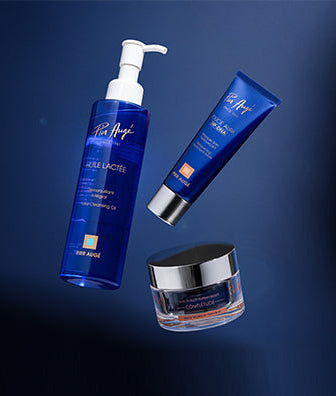
For those who want the full repair experience, Pier Augé offers the PDRN Skin Barrier Repair Set, which pairs the Douce Aura Overnight Mask with the Gentle Lotion Active Tonic, a PDRN-infused hydrating toner containing hyaluronic acid and pomegranate ferment for antioxidant support. The toner preps the skin with DNA repair ingredients, and the mask follows with overnight regeneration. Together, they create a repair cycle that sheet masks cannot replicate.
What Face Masks Can and Cannot Do
Face masks are useful tools. The right one, used at the right frequency, can address dehydration, dullness, oiliness, and even signs of aging with results you can see by morning.
But they are not replacements for a consistent routine. A mask delivers a boost — the daily work of cleansing, moisturizing, and sun protection is what keeps skin healthy over time. And for repair that goes deeper than surface hydration, formulation science matters. The difference between a mask that plumps and a mask that regenerates is the difference between water weight and structural change.
Pier Augé's approach to masking — biomimetic ingredients, clinically tested concentrations, repair-first philosophy — represents what happens when a mask stops being a cosmetic treat and starts being a dermatological tool. Whether that level of commitment matches your skincare goals is a personal decision. But understanding what face masks actually do means understanding that not all masks do the same thing.